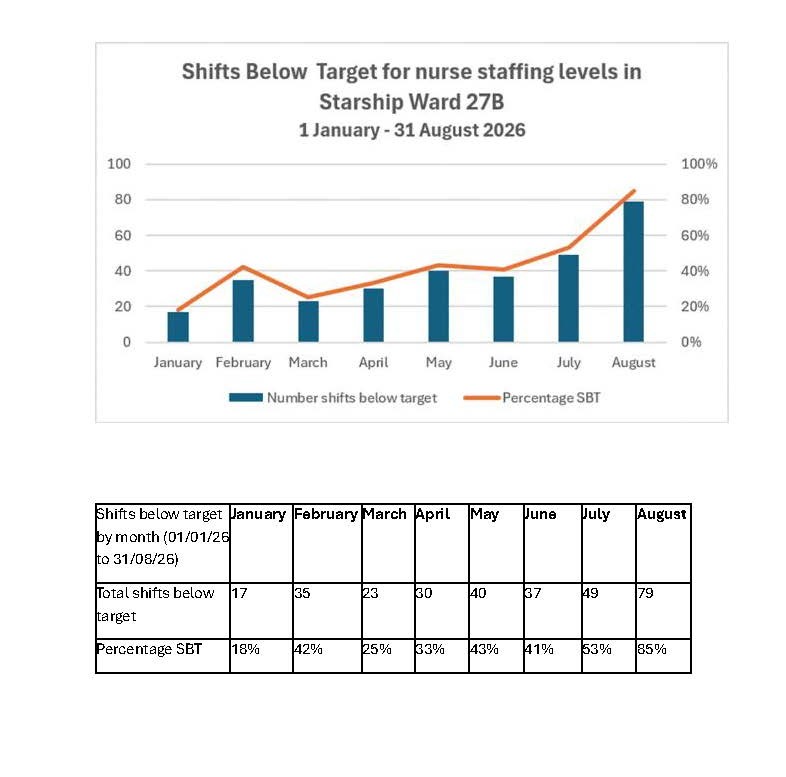
Te Whatu Ora data obtained by NZNO shows the oncology ward at Starship Children’s Hospital was short of nurses on 85% of all shifts in August, NZNO says.
Tōpūtanga Tapuhi Kaitiaki o Aotearoa NZNO Kaiwhakahaere Kerri Nuku says the Shift Below Target data, obtained under the Official Information Act shows staff shortages have continued to worsen this year.
"The haematology/oncology ward 27B at Starship has been under-staffed all year and Te Whatu Ora should have hired more nurses before they were forced to suspend vital cancer treatments for sick children.
"It shouldn't have come to this. Nurses have been crying out for the past two years about the risk to patient safety caused by deliberated short staffing.
"This year alone, 42% of all shifts on the oncology ward - or 310 shifts out of a total of 729 - were below safe staffing levels.
"This is an increase from last year when 31% of all shifts - or 342 shifts out of a total of 1095 --were below safe staffing levels," Kerri Nuku says.
The data also shows the actual number of nursing hours short in ward 27B has increased by 262% since 2025. In 2025, Te Whatu Ora reported a clinical care hours variance (nursing hours short) of -466 hours and in the 2026 year to August, a care hours variance of -1613 hours was reported. In August alone the ward was short 1,125 hours for nursing staff.
"This is equivalent to 6 full-time nurses short in the haematology and oncology inpatient ward for August," Kerri Nuku says.
"Health Minister Simeon Brown can argue oncology services are being postponed and not suspended but such semantics are unlikely to be important to whānau with children with cancer," she says.
Editor notes:
- Shift below target refers to whether the staffing levels for a shift are safe for both staff and patients. Shifts below target is the number of shifts where the difference in staffing hours supplied and the care hours needed by patient acuity is greater than negative 8.5% (or 40 minutes per FTE). Shifts below target indicate a heightened level of risk for patient safety, patient outcomes and nursing workforce safety and morale. Shifts below target mean there is inadequate staffing in either the numbers of staff on the floor or the skill mix and competencies of staff available to provide patient care. This can increase the incidence of adverse events or near misses such as falls or medication errors, care rationing where care is missed, delayed or suboptimally delivered or in some cases work left undone due to lack of time, resource or communication. Patient mortality increases with exposure to increased number of shifts below target.
- Clinical variance is calculated as available clinical hours minus required hours. The required hours are generated through TrendCare, where nursing staff assess and record the care needs of each patient. This produces an expected level of care based on patient acuity. As such, a negative value indicates that the required hours exceeded available staffing hours for that period.